
Episode 34
“The Journey Is the Best Part” — Nadine’s Story
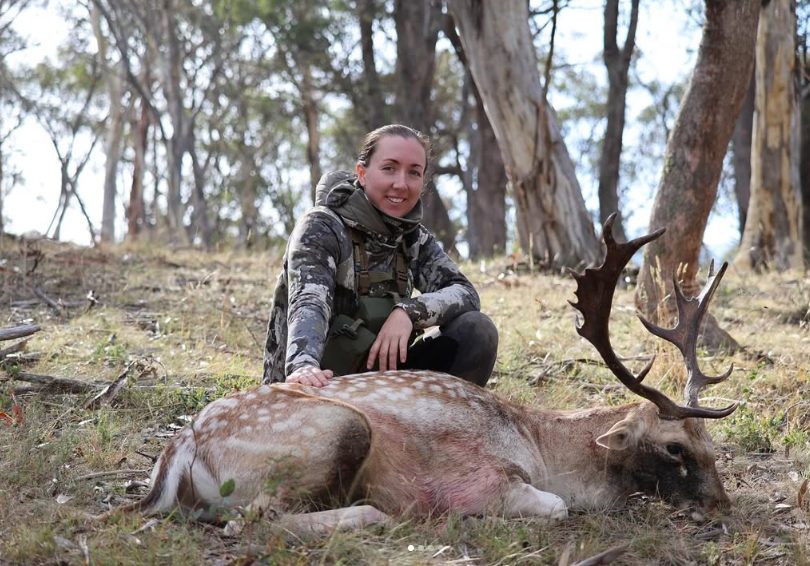
Nadine Harte didn’t grow up in a hunting family. Nobody handed her a rifle, a mentor, or a map. A bloke she dated at nineteen introduced her to hunting — and when that chapter closed, she made the decision that’s defined the ten years since: I can do this on my own. One terrifying trip to the gun store later, she walked out with a stainless .308 Tikka, and walked into a hunting life built entirely with her own hands.
Picture Nadine’s first solo hunt. A thirty-dollar Kmart backpack with nothing in it — she reckons she thought it was part of the look. Cheap camo, because women’s camo barely existed then (and, she’d argue, still barely does). One knife somebody had given her years earlier. No sharpener. No meat bags. No binos. Just the Tikka she’d picked out — shaking, reading off a scrap of paper — with the help of some very patient blokes at the gun store, and access to a mate’s property and the words just come up for a walk, you’ll be fine.
She shot her first deer — a fallow spiker — on that first solo walk. She’d crouched low when she spotted them on the ridge, eased up behind a tree with her heart hammering, told herself to settle down, and dropped him with one shot.
“He went down straight away and I was just like — holy. This is what it’s about. Being out there on your own. From that day on, that’s what had me.” — Nadine, on her first solo deer
Then reality arrived: it took her three or four hours to deal with that deer. The legs and backstraps went home whole, stuffed in the Kmart backpack. Too much skin came off, half a back leg was lost to the fridge, and the celebratory venison schnitzels — her first meal off her first animal — tasted, in her words, like I had a lot more to learn. But that’s exactly the point she wants beginners to hear.
“It’s okay to have no idea. That’s how you start. Being a beginner is about not knowing.” — Nadine
The learning came fast, and she chased it hard. The bravest chapter: seeing a free butchering school advertised up at Jamieson, packing the car alone at twenty-two, and rolling up to find twenty or thirty blokes. It turned out to be one of the best weeks of her hunting life — skinning, gutting, breaking down animals properly — and the boys taught her heaps. Her pattern was set: educate yourself between hunts, find people to learn from, and never let being the only woman in the room stop you walking in.
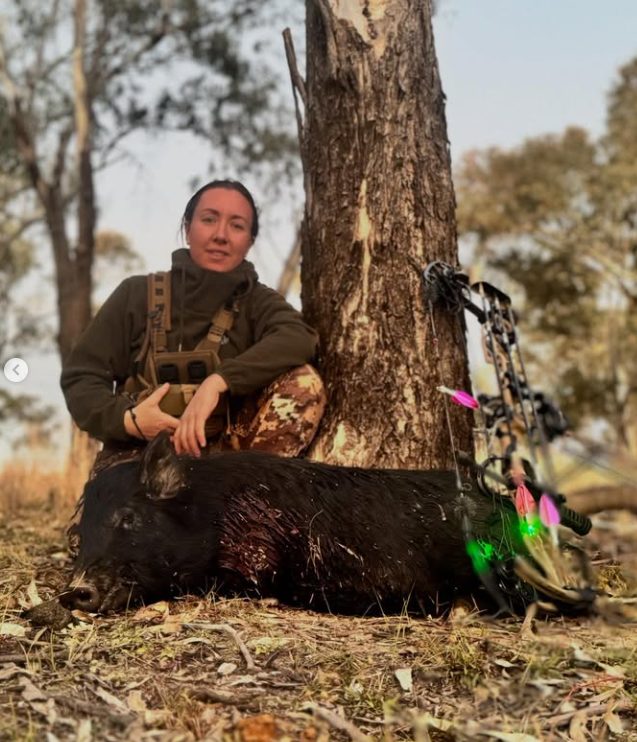
COVID pushed Nadine’s story sideways in the best possible way. Working in WA while her rifles stayed in Victoria — where the hunting was better, and flying guns back and forth was a nightmare — she found herself between backpack-hunt trips home with itchy feet and expensive supermarket meat. The solution: a three-hundred-dollar bow off Marketplace, complete with a bundle of dodgy arrows.
She’s adamant that scrappy start was perfect. The cheap bow answered the only question that mattered — do I like this? — without burning serious money. The local bow shop connected her with another woman who bowhunted in WA, afternoons of flinging arrows turned into a shot rabbit, and the rabbit turned into an upgrade: her beloved Mathews, and no looking back.
“Start with what you can afford. If that’s a cheap bow and cheap arrows, do it. You’ll outgrow them — but they’ll tell you if you love it first.” — Nadine, on getting started
Somewhere in the middle of all this came the best Marketplace find of all: Ben. They met, of all ways, hunting the same farm at the same time without knowing it — the farmer let each know the other was out there, then invited them both to dinner. Ben was a compound shooter until an eye injury moved him to trad bow — “a stick and a string,” as Nadine describes it, shot on pure instinct like throwing a rock — and now the two of them hunt as a team, compound and trad, working off each other in the bush.
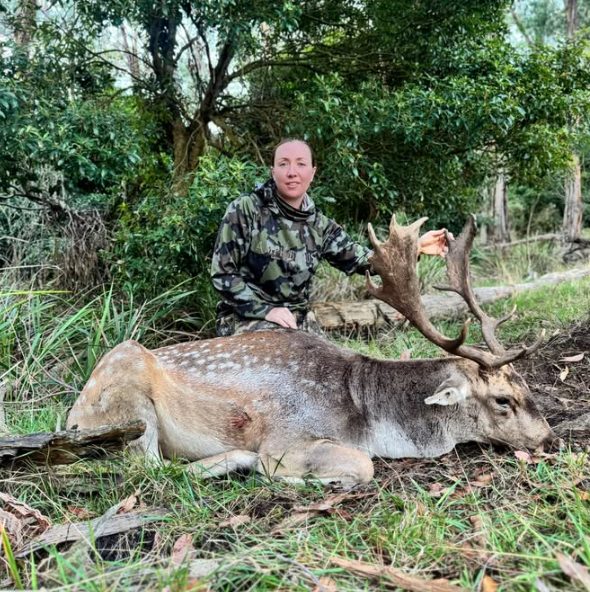
Here’s the most honest part of the episode: the war between Nadine’s rifle and Nadine’s bow. Because for a long time she carried both — and every time the bow broke her heart, the rifle was right there offering an easy win.
And the bow broke her heart constantly. Full draw on a beautiful buck at eighteen metres, arms burning because she’d drawn way too soon, leaning around the tree a fraction too far — busted. A buck coming in to the rattle that caught the movement of her draw and ducked her arrow entirely. (Yes, ducked. “They’ll turn themselves inside out,” she says of string-jumping deer — you don’t believe it until you watch an animal fold itself out of the way of your arrow.) After each heartbreak she’d take a deer with the rifle, feel that hollow little pang of disappointment, and realise she’d robbed herself of the harder, sweeter version.
“You have to be disciplined. If you want to shoot stuff with the bow, you have to put the gun down. That’s what I’ve learnt.” — Nadine
So she did. These days the rifle stays home and only the bow travels — and the results have followed. Her first bow deer was a red doe, taken with Ben at her shoulder after a masterclass stalk: fifteen reds cresting a hill, a crawl across open paddock, a bank at thirty-five metres, wind shoving her around, drawing low behind the cover and rising to shoot. And in classic Nadine fashion, her takeaway from the moment everyone said would be the peak was beautifully contrarian: with a rifle, the shot is the high; with a bow, it’s everything before it — the misses, the busted stalks, the twenty-five-metre near-things that get your blood going.
The bow has also rebuilt how she thinks about shooting altogether. A broadhead is only so wide, so the angle of the animal is everything — quartering toward, quartering away, where the exit will be, where the heart sits when the leg is forward. It’s anatomy she wishes she’d been taught as a rifle beginner, when the advice was just “straight up the leg” — and she reckons a couple of deer lost over the years trace back to exactly that gap.
Best shared moment: Nadine at full draw on one of her first fallow bucks as the light died, forced to draw down because her peep had gone dark — and as the buck stepped right, Ben’s green-fletched arrow came flying in from the side. His first fallow buck. Fist pumps all round, because in their team it doesn’t matter who made it drop.
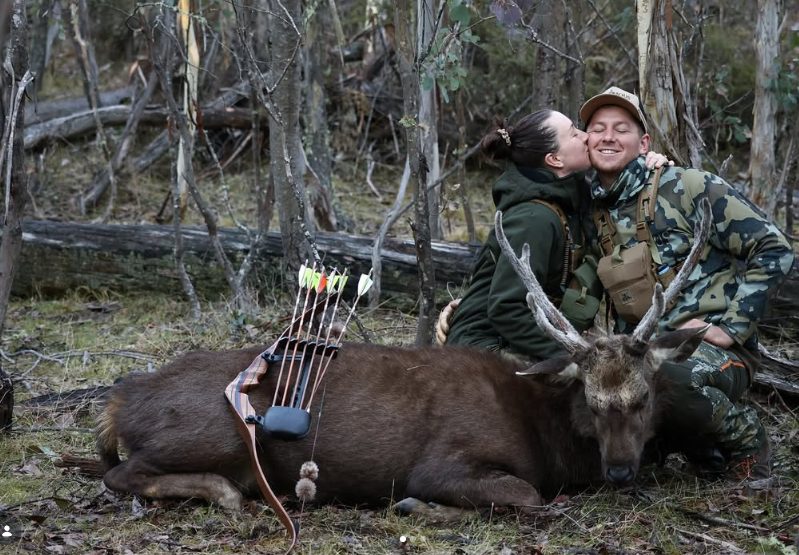
Ask Nadine about sambar and something changes in her voice. She’s taken good stags with the rifle — including a meat stag whose two back legs were so big they took two separate trips up the hill, each leg its own carry — but with the bow, the ghost deer of the Victorian bush remain unfinished business. She’s had them come in to the doe whistle like freight trains; she’s had a doe crash-bang to thirteen metres behind her while she sat frozen, unable to turn, until poof — gone. She’s heard the honk up close, the one that rattles through your whole body and, on first exposure at a bush camp as a young hunter, made her briefly certain her world was ending.
“They’re like a ghost. You don’t even know they’re there. They’re just so in tune with the bush — it’s phenomenal.” — Nadine, on sambar
The lesson sambar have taught her came via an old fella she hunted with years ago, and it’s the best single line in the episode: Nadine, you’re going too fast — you can’t see the birds. Now, in the thick stuff, she slows down until she’s spotting the birds again. Give the animal credit. It lives there. You’re the visitor.
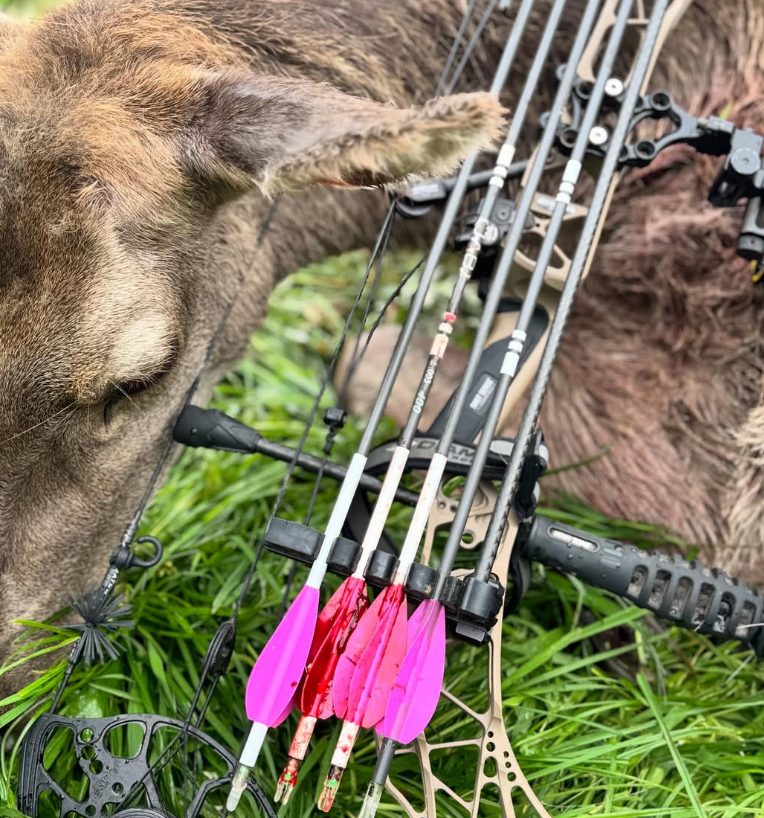
Push Nadine on what she wishes she’d known from day one and the answer is immediate: wind and thermals predict everything. She thinks of all the mornings she wandered straight down a gully with the thermals pulling her scent ahead of her like a town crier, then wondered why the gully was empty. Her fix is a little wind puffer on her bino harness — but used as a teacher, not a crutch: guess first, then puff to check, and slowly train your brain until the guesses come right.
And then there’s the story every hunter reading this needs to hear: the laundry detergent. Nadine was a proud sceptic — wash the hunting clothes in whatever, it doesn’t matter. Then a mate watched her getting pinged by goats at two hundred metres and staged an intervention: normal detergent has UV brighteners, and in sunlight it turns you fluorescent to animals. She surrendered her clothes, he washed them in plain soap, and the difference was staggering — from busted at two hundred to inside fifty metres with goats looking straight through her.
“He said, ‘you’re fluorescent to them.’ I’m a bit stubborn, but sure enough — I will not wash my hunting clothes in normal laundry ever again.” — Nadine, converted
Her other hard-won advice for beginners: build genuinely good shooting practice — squeeze, don’t punch; shoot from every position you might actually find yourself in, not just prone off a tripod at home; and stretch your practice distance past your comfort zone, because when the long shots feel routine, the two-hundred-metre real ones feel easy. Learn to process an animal before you need to. And accept, in advance, that you’ll make mistakes — because that’s not failure, that’s the apprenticeship.
Nadine works in a male-dominated industry and hunts in one, and her take on being a woman in this world is characteristically level: she’s no different from the blokes, and doesn’t want to be treated as though she is. Where she does see a difference is the doorway in — the daunting walk into a store full of men’s gear, the missing women’s sections that Canada and New Zealand sorted out years ago, the everyday women quietly killing it every weekend with no platform at all. That’s the gap she wants to work on, alongside women like her mate Emma Sears — and it’s why she’s started The Wild Collective, and why her DMs are wide open.
“There are some killer women out there in Australia doing epic things. We’re here to stay, we’re gonna get it done, and we can do it on our own.” — Nadine
Her door-is-open policy is real, not rhetorical. She still reaches out to the boys herself — she’s picking a new sight for her bow right now and bouncing options off her mates — and some of her closest friendships, like Beth from Wild Deer magazine, started as a message from a stranger. So slide into the DMs. Ask the “stupid” question about bullets or poundage or draw length. If someone doesn’t reply, don’t be disheartened — they probably didn’t see it. And if you’re bow-curious: most bow shops love beginners, a store fitting beats guessing your draw length off the internet, and poundage is personal — Nadine’s five-foot-four shooting fifty to fifty-five pounds, and women out there are pulling everything from twenty to eighty-plus.
What’s next? A bow trip to New South Wales this week, a couple of secret missions she’s keeping on the down-low, a return to New Zealand — she spent a month there and lost her heart to the place — and priority number one: her first fallow buck with the bow, the one that’s dealt her “way too much heartbreak.” In the meantime she’s collecting the small wins that bowhunting runs on, like the hare she finally took last week after twelve months of near misses. And she’s made one more commitment on air: getting Carly onto a bow. Her exact warning — once you start, you’ll become a bit of an addict.
Nadine — thank you for the honesty. For telling the version of the story that includes the lost meat and the ducked arrows and the discipline it takes to leave the rifle at home. Ten years of building it yourself, and now you’re building the doorway for the next woman through. We can’t wait to see that fallow buck fall — and don’t think for a second we’ve forgotten about getting Carly behind a bow.
Find Nadine
Nadine’s platform is open and she means it — questions, gear advice, or just “where do I start?” are all welcome. Find her on Instagram at @nadine_b_harte, and keep an eye on @thewildcollectiveaus as The Wild Collective grows.
Nadine’s People & Gear
Running through this episode: Ben, the trad-bow-shooting partner she met when a farmer played matchmaker; the mates at Jab Stick Outdoors and Kayuga Broadheads who keep her quiver honest; the patient blokes at her first gun store and the butchering school boys at Jamieson who taught a nervous 22-year-old the trade; and Beth from Wild Deer magazine — proof that a DM can turn into a friendship that debriefs every hunt.
Ep. 34 — Nadine Harte on solo starts, switching to the bow, sambar & hard-won advice
Open the podcastKey takeaways
- You don’t need a mentor or a family history — Nadine built ten years of hunting from a Kmart backpack and one knife.
- Being a beginner is about not knowing. That’s the starting point, not a disqualification.
- Start with gear you can afford — a $300 Marketplace bow answered the only question that mattered.
- If you want to shoot with the bow, put the rifle down. Discipline is what makes the results come.
- Wind and thermals predict everything — and normal laundry detergent makes you fluorescent to animals.
- Slow down until you can see the birds again. The animal lives there; you’re the visitor.
Keep the journey going.
Step into the community and find your next weekend in the bush.
Related stories
Episode 36
“Scared, and Doing It Anyway” — Farrah’s Story
Farrah Buckland picked up a firearm because it terrified her. That decision became Girls with Guns Australia, a community selling out come-and-try days for first-time women shooters.
The Story
GTA in the Wild Has a New Name: Meet WildHeart Pursuits
GTA in the Wild has outgrown its name and is now WildHeart Pursuits. Gun Traders Australia and Women Who Hunt both carry on as they are. Here's why our adventure and storytelling content needed a home of its own.
Episode 35
She Walked Out Empty-Handed. She's Going Back Tomorrow.
Kate grew up on a small farm in Manjimup, Western Australia — the youngest of five kids with state forest stretching out across the road. After years of FIFO work in the Pilbara, she found her way into bow hunting through her partner Brett, and hasn't looked back since. Her first real hunt came through Her Outdoor Journey — a beginner women's trip in NSW. She walked out empty-handed. She went home completely hooked. From there she joined a women's bow hunt in New Zealand with Precision Helicopters: chamois country, steep terrain, a December snow flurry settling into the basin, and a steep learning curve to match. Kate is still learning. She still hasn't taken an animal. And by her own account, she's loving every single minute of it. In between hunts she's out with her daughters Amelia and Quinn — teaching them to light fires, read scat, sleep under the stars, and fall in love with the bush the same way she did. This one's for every woman who's come home with an empty pack and a full heart.