HERO
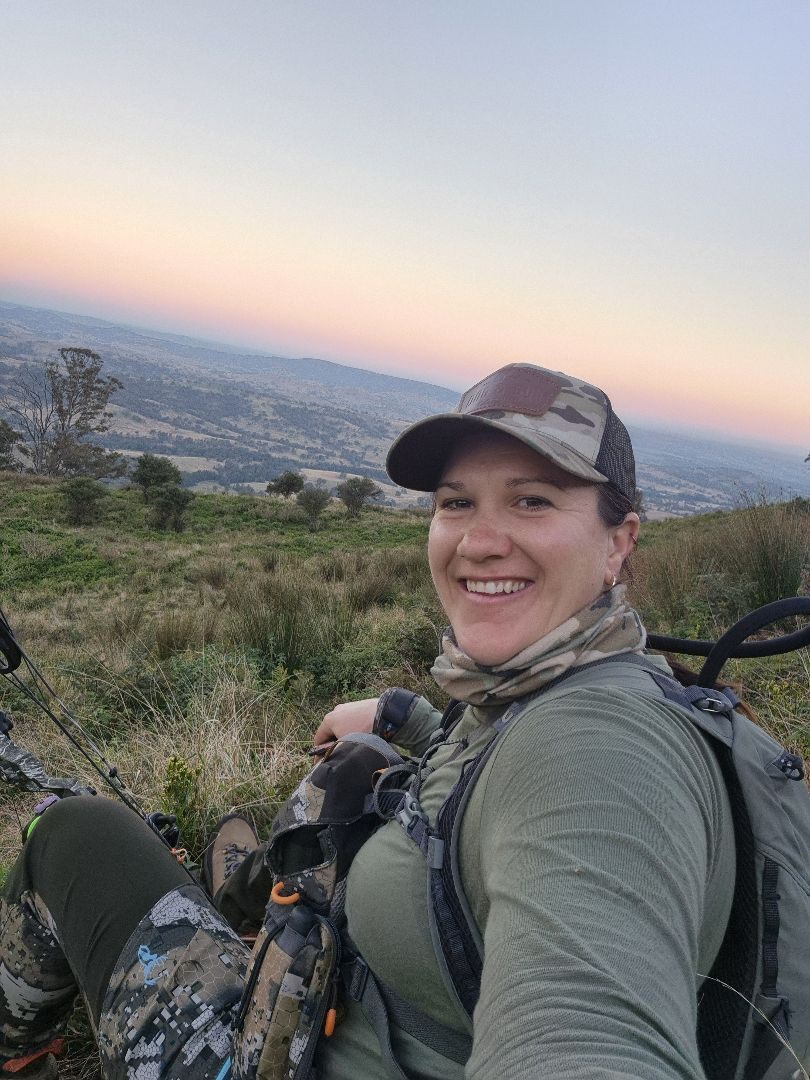
Kate (Little Wanderer) at dusk in the Australian bush with her bow and backpack

Women Who Hunt Podcast · Episode 35

She Walked Out Empty-Handed. She’s Going Back Tomorrow.

From farm kid to bow hunter, Kate is right in the middle of the journey. She hasn’t got an animal on the deck yet. And she is absolutely hooked.

Guest: Kate • @alittle.wander  •  Episode 35  •  ~76 min

LEDE

Kate grew up in the lower southwest of Western Australia — five kids, a small farm, no-through roads to state forest, and a mum who kicked everyone outside before lunch. She never thought of herself as a hunter. She wasn’t even sure she was particularly outdoorsy. But there’s something that happens when you pick up a bow, stumble onto the wrong end of a wind change, sit still long enough to hear your own brain argue with itself — and find yourself planning the next trip before you’ve even unpacked from the last one.

BODY

Growing Up Country

Kate grew up in a little town called Manjimup in the lower southwest of Western Australia — the youngest of five, on a small farm, with state forest right across the road. “We used to go swimming down the dam in the summer and ride the four-wheeler around the place,” she says. “We lived down the bottom of a no-through road. We built cubbies in the bush.”

Her mum banned TV during the day. With five kids running around, you can see why. “I was really lucky,” she says. “I just didn’t realise it until I was way older.”

By her teenage years, she was swag-camping along the rivers with whoever had a two-wheel drive and a little esky. No big planned expeditions — just a spontaneous overnight wherever the road ran out. She loved being outside. She just hadn’t named it yet.

Sheep Work and Finding Her Feet

Kate finished school with no desire to go anywhere near a desk. “I’m not an academic,” she says cheerfully. “I’m more of a sit, watch, do, and ask questions kind of person.” She tried a bridging course for university, but when the bar on campus kept calling her name, she called it. Went job hunting instead.

She found work doing sheep work on properties in the lower southwest — hard graft, outdoors all day, rain or shine. “It’s definitely a way of life, not just a job,” she says. “You don’t go there to make millions. You do it because you enjoy the gig.” She worked under good people, met great people, got kicked into touch when she needed it. She looks back on those years as a formative kind of growing up: stable enough to learn, free enough to be outside almost every hour.
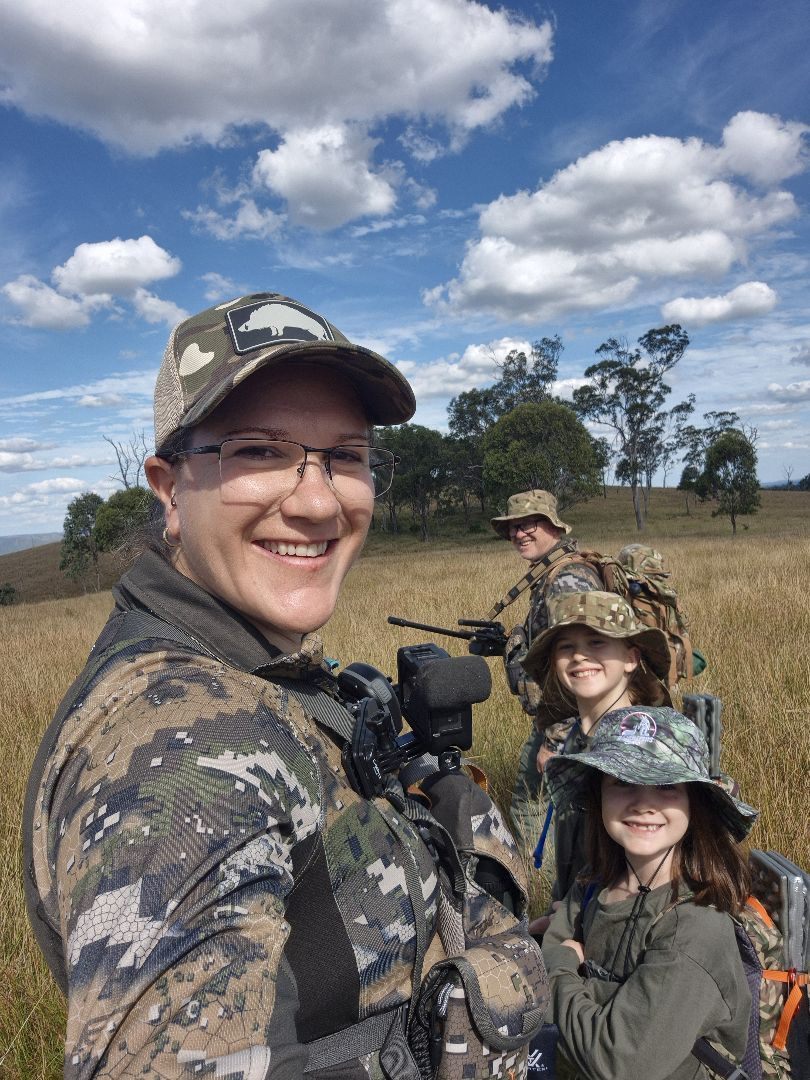
Kate and Brett with daughters Amelia and Quinn in golden Australian bush grass

Brett, Kate, Amelia and Quinn. The whole family’s in on it.

Brett, Bows, and Picking a Lane

After the farms, Kate headed north to the Pilbara for FIFO work on the LNG fields. That’s where she met Brett — over a cup of tea, when he noticed she swapped her belt buckles. “We just clicked,” she says. They were mates for a few years before things shifted.

Brett had always hunted. Kate knew there were bows in the shed, but FIFO life — two weeks on, two weeks off — made their time at home about decompression, not new hobbies. Then one afternoon in 2012 on the Sunshine Coast, Brett was flicking arrows in the backyard. Kate wandered over. “I thought, I reckon I’ll have a pop at that.” He set up a bow. She had a go. She liked it.

Life intervened — an eye problem, then the girls — and archery went quiet for a while. But when she picked it back up, she knew she wanted more from it than target practice. The question was: film and create, or actually hunt? “Do I invest my time and energy into the filming? Or do I invest more heavily into the actual hunting?” She picked hunting.

“These animals — their whole job is survival. Like, in every sense, that is their sole job of their existence. It’s gonna take a bit to beat that.”
— Kate

The First Real Hunt

Kate found a beginner women’s hunt running in Australia through an Instagram account called Her Outdoor Journey — Courtney’s channel from America, which she’d stumbled across while deep in the hunting corner of Instagram. “I mentioned it to Brett and I was like, this would be kind of fun to test my teeth on.”

Brett worked his ass off helping her get organised. She’ll admit she lacked confidence in her own ability — “I like to be solid in what I know and then I’m fine. Whereas if I’ve got a little bit of self-doubt hanging around, I do let it override sometimes” — but she went anyway. Four days, a fantastic bunch of women (mostly American, all brilliant), and more animals around than she’d ever seen.

She didn’t get one. Her hat blew off at the wrong moment. The pigs said, “Yeah, I’m alright for that, thanks,” and vanished. The wind caught her out. She was too noisy, too heavy with her steps, not slow enough, not patient enough.

She was absolutely hooked.

“As I said the other day — I haven’t even got an animal on the deck yet,” she tells Carly with a laugh. “So it’s really funny when you say to people, ‘yeah, I’m going hunting’ and they’re like, ‘what have you got?’ And I’m like…”

“I’ve got thin air, mate. Like, I’ve got nothing yet. Yet. I will get there.”
— Kate

Raising Hunters: Amelia, Quinn, and the Family Bush Life

Amelia is ten. Quinn is a bit younger. Both girls have grown up immersed in the hunting lifestyle — not exactly by choice, but they’ve taken to it in their own ways. “We talk about hunting a lot. We watch hunting YouTube videos. The girls are immersed in it.”

Amelia’s the keener one. “Little hawk eyes,” Kate calls her — she’ll spot scat on a trail and start cross-referencing it with what she knows about deer. Quinn prefers conditions to be just right: not too hot, not too cold, just in the middle. Both of them will take the binoculars and have a proper look. Both of them ask when they’re going back out.

When Kate took Amelia out for the first time — head-high grass, Queensland summer, hot as balls — Amelia just strapped on her camel pack and followed. Zero complaints. “That’s what I want for them,” Kate says. “I want them not afraid of hard.”

The girls can use a ferro rod to light a fire. They understand that you collect your tinder first and build up from there. They know why you cook your dinner on the fire you made yourself. “Connect the dots,” Kate says. “I think that’s important for kids.”

“I want them not afraid of hard. I want to choose their hard, but I want it to be accessible and I want them to feel capable — that they can head out and just have a crack.”
— Kate
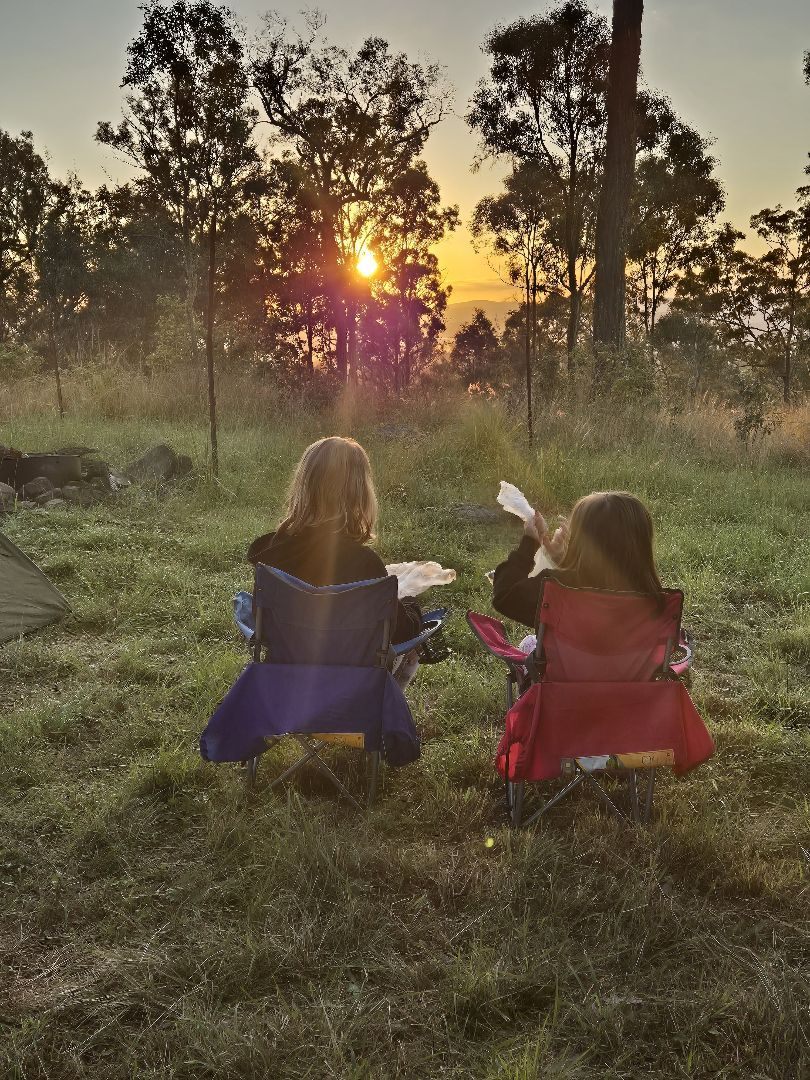
Amelia and Quinn watching a golden sunset through Australian gum trees

Amelia and Quinn. They always want to know when they’re going back out.

New Zealand: Snow, Chamois, and the Learning Curve

A spot opened up on a New Zealand hunt. A couple of people had dropped out. Carla got in touch — you want to come? Kate told Brett she was nervous. She was super green, hadn’t been to that part of NZ, didn’t have Brett as a safety net. He said: book it. Or I’ll book it for you.

She booked it.

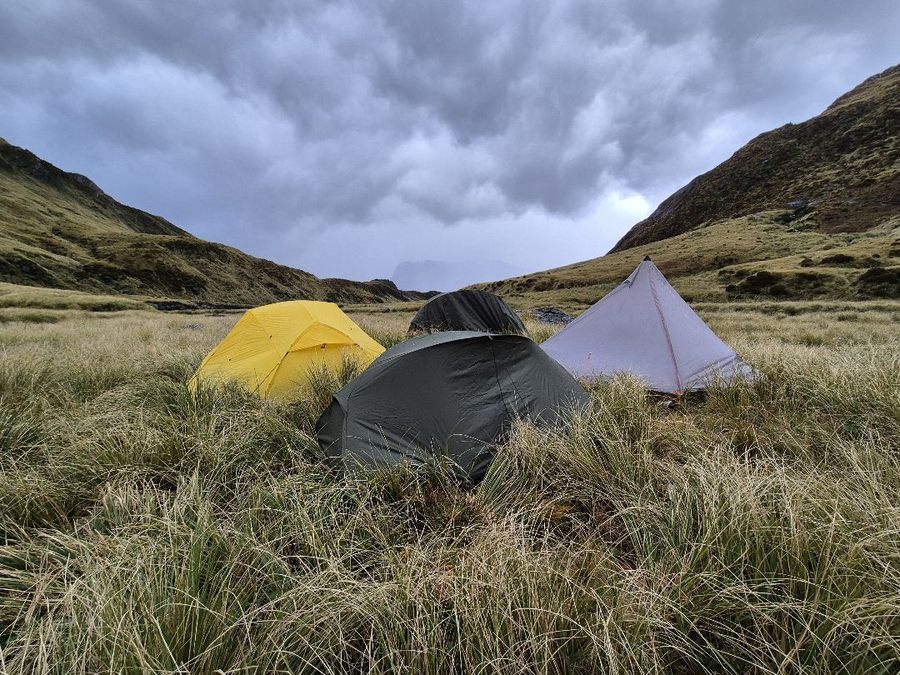
The trip ran through Precision Helicopters — Ellie’s family’s operation — dropping them right into a high-country basin. One quick creek crossing and they pitched their tents, a mountain wall rising on every side. “I was like, how far are we walking?” Kate says. “Nah, we’re just pitching up over there. Thank gosh. I’ll have a coffee to that, thank you very much.”

When they landed it was partly cloudy, warm enough. By afternoon, the clouds rolled down the back of the basin. It rained through the night. They scrambled out at 8:30pm in the brief reprieve — cooked dinner, made coffee, fetched water from the creek, got back in before the rain returned.

By the time Kate layered up in her puffer jacket, her winter hunting pants and a pair of heavy-duty merino wool socks, something still felt wrong. Then a tent zip opened: come and have a look. There’d been a snow flurry. The whole ridgeline had gone white overnight. “In December,” she says. “From Queensland. No wonder I was so bloody cold.”
FULL-WIDTH PHOTO: NZ TENTS
Three tents pitched in NZ tussock under a dramatic stormy sky

The basin in New Zealand. That ridgeline turned white overnight.

The next morning they went up the basin in 150-metre bites — move, sit, glass, move again. A young deer wandered almost into camp on the first day — she describes watching him bounce between curiosity and suspicion, “the dopey bastard” turning back just as the more experienced women grabbed their rifles and sprinted up the hill. Courtney from Her Outdoor Journey got a chamois. Kate had her bow and came home with exactly what she came for: “Solid life lessons and some friendships along the way.”

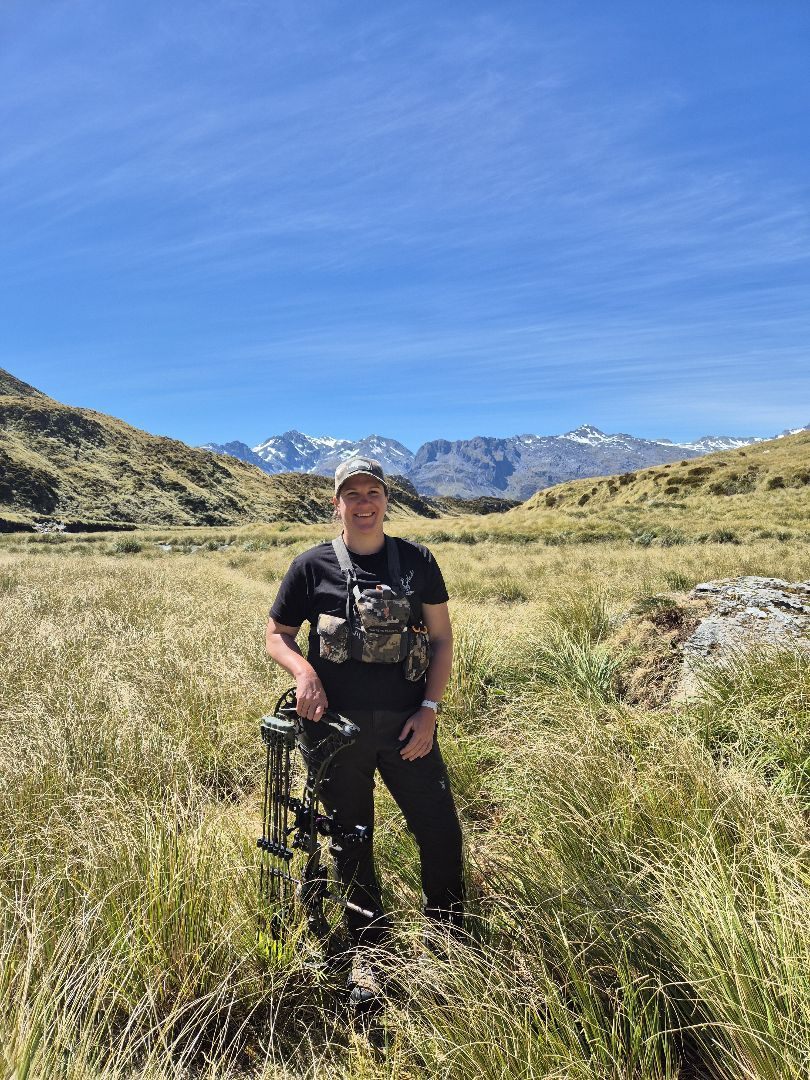
Kate standing in NZ tussock with her bow, snow-capped mountains behind her
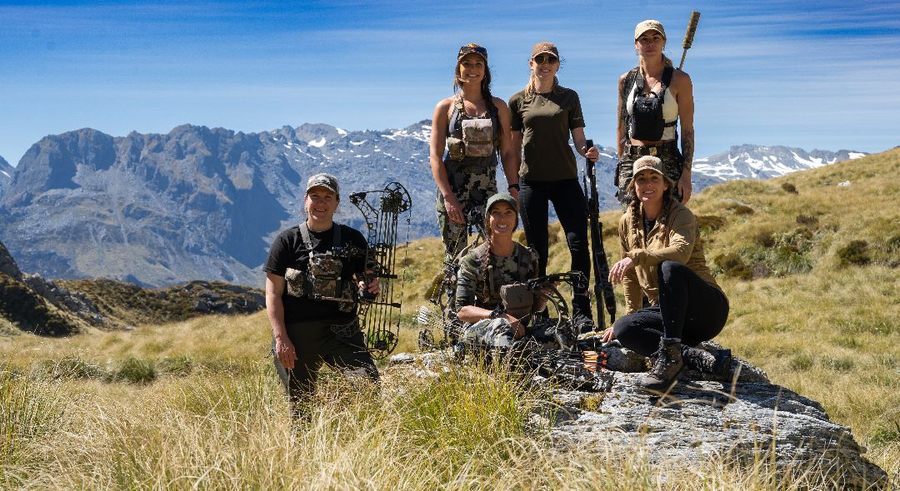
Kate and five other women on a New Zealand mountain ridgeline

Left: glassing country on the NZ hunt. Right: the crew on the ridgeline — these women were phenomenal.

The Kiwis, she says, are “phenomenal little jackrabbits — they just punch up a hill and look at you like, what are you doing?” She was sucking on her asthma puffer trying to keep up. She loved every minute.

The following year she took the family back for her fortieth birthday — a South Island road trip, a glacier chopper tour, and an aerial pass right over the basin where she’d hunted. The girls could finally see where Mum had been. And when the pilot spotted a mob of deer on the ridgeline, it was Amelia who found them in the window first.

“Every time you go out, you learn something new.”
— Kate

Back in Australia: Building the Toolkit

Since New Zealand, Kate has done several solo hunts in Australia. She’s had the wind change at the worst possible moment, stood frozen watching her whole hunt unravel. She’s hiked down into gullies she had to climb back out of in the dark. She’s learned to glass more, wait more, second-guess herself less.

“The last hunt on my own, I definitely worked a lot bloody harder than I had previously,” she says. “Because I was like, to get the reward you gotta put in the work. And when you’re heading down, you think, I’m gonna have to come back up this. But you’re committed. So you just keep going.”

She went to America earlier this year — caught up with the Her Outdoor Journey crew and a whole bunch of women she’d never met in person, doing a retreat. She laughs about the cultural gap: the Americans worried about snakes while casually packing bear guns. They’re counting down to elk season on Instagram. “I mean, they’ve got countdowns. They’re training, flicking arrows like there’s no one else’s business.”

She loved it. And she came home wanting more time in the field. Brett is heading off on a chital hunt shortly — she’s buzzed for him. Her next goals: more hunts, more hours in the country, and a butchery course. “I’d really like to actually book a course and go and do that. I want to be able to teach my kids butchering — because I don’t know, squat, and that’s something I want to learn.”

What It Means to Be a Woman in the Field

Carly’s closing question — what does it mean to you, being a woman in this world? — doesn’t get a grand answer. It gets a real one.

“I just love pushing for something that’s not so popular, I guess,” Kate says. “I think it’s important to be able to share the buzz and the hype of what it actually is — to other people, or even just to a friend who loves bushwalking and might go, hey, there’s a couple of deer, should we have a look?”

She talks about the gap she sees — women who want to be in the field but aren’t sure how to start, aren’t sure they’re welcome, aren’t sure who to ask. Her answer is just: ask. “I’ll send someone a message anytime. If I want to know something, I’ll flick them a DM. They’ll read it and like it, or they’ll answer you, or they won’t. It’s neither here nor there.” She has never yet met someone in the hunting community who wasn’t happy to share.

“Just ask the questions. Don’t be afraid to talk to people. Because majority are just happy that you’re stepping into the space.”
— Kate

She’s also thinking about her daughters. About what she’s handing them. Studies say girls lose up to 40 per cent of their confidence somewhere between eight and twelve. Kate is aware of this. She is deliberately arming Amelia and Quinn with skills — the fire, the country, the binoculars, the patience, the knowing — before that window closes.

“If I can give that back through learning skills and out-of-the-box stuff that’s not your usual go-to girl things,” she says quietly, “I’d love that for them.”

And if Kate herself gets an animal on the deck soon? She says she has no doubt she will. She’s not in a hurry. Every hunt teaches her something. The thin air is real — no trophy on the wall, no meat in the freezer yet — but she has the mountains and the wind and the scat and the gully and the coffee at first light and the girls watching the sunset through the gum trees.

That’s not nothing.

“You don’t have to start huge. You don’t have to know all the stuff. Just set a small goal — and give it a crack.” — Kate

⋅ ⋅ ⋅
🎙

Episode 35

Women Who Hunt Podcast with Kate • @alittle.wander

Listen to the full episode

Find Kate

Kate — A Little Wander

Brands & Shout-outs

Mentioned in this episode

  • Her Outdoor Journey (@heroutdoorjourney) — Courtney’s channel; beginner women’s hunts that gave Kate her first real taste of the field
  • Precision Helicopters — Ellie’s family company in NZ; helicopter drop-ins to high country for the NZ women’s hunt
  • Ferro rod — Kate teaches Amelia and Quinn to light fires with one on camping trips
  • Jetboil — “You can even take your Jetboil and have a coffee. I just don’t understand why more people aren’t doing this.”
  • Wild Socks / heavy-duty merino wool socks — what Kate reached for when the NZ snow flurry hit in December
  • Down Under Taxidermy
  • Brakenwear
  • LOWA Boots Australia
end container FOOTER